

Salt water is one of the most aggressive environments for any metal material. In industrial fishing, this has a direct consequence: a fishing weight that degrades prematurely means more replacements, more cost and more material lost on the seabed. Choosing the right material is not just an environmental question, it is a technical decision with a direct impact on operations.
At GreenCastSea we face this question constantly, because it is the foundation of our product. Here we compare, objectively, how three common fishing weight materials perform against corrosion in salt water: recycled zinc, lead and steel.
Lead: good corrosion behaviour, poor overall balance
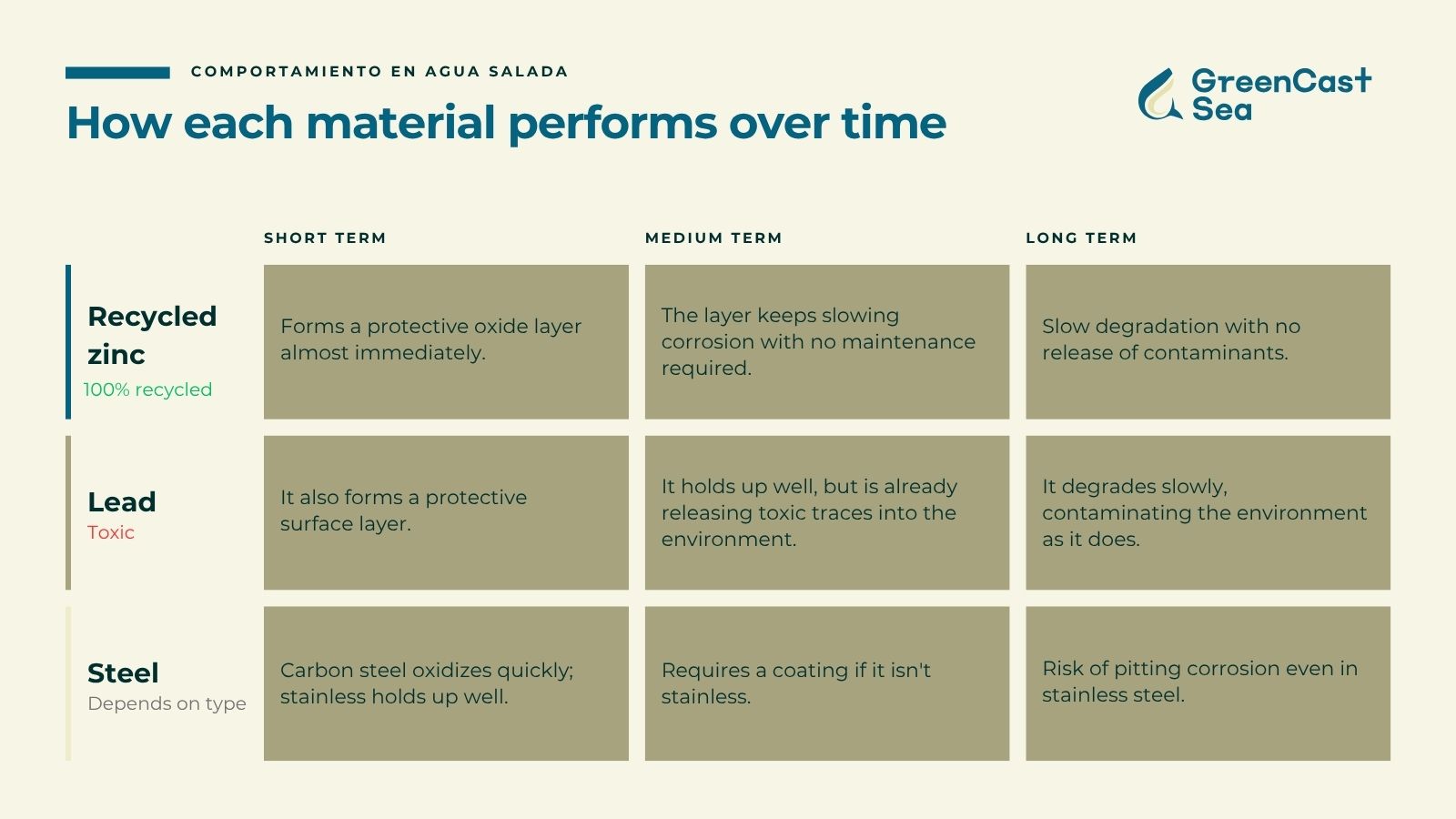
Lead has traditionally been popular in fishing gear for its high density and reasonable resistance to corrosion in salt water, as it forms a surface layer that slows its degradation. However, this resistance does not offset its main drawbacks: it is a toxic metal, with well documented health and environmental impacts, and its use is increasingly restricted by specific regulations in fishing. A material that corrodes slowly but releases contaminants as it does so does not solve the problem, it only delays it.
Steel: high mechanical strength, corrosion dependent on type
Steel's behaviour against corrosion varies widely depending on its composition. Carbon steel oxidises relatively easily in salt water without coatings or anti-corrosion treatments, while stainless steel offers better resistance thanks to its chromium content, although it is not exempt from pitting corrosion under prolonged exposure to chloride. In fishing weights, steel generally requires a greater volume to reach the necessary density, which can affect the design and hydrodynamic behaviour of the rig.
Recycled zinc: a balance between performance and sustainability
Zinc alloys offer notable corrosion resistance in salt water, thanks to the protective oxide layer that forms on their surface, similar in concept to that of other metals used for cathodic protection on marine structures. Compared with lead, it removes the risk of toxicity. Compared with untreated carbon steel, it reduces the need for additional coatings. Furthermore, as a 100% recycled material, it maintains technical performance without depending on the extraction of new raw material.
This combination of corrosion resistance, density suited to fishing weights and absence of toxicity is why at GreenCastSea we manufacture our Itsaspe range from recycled zinc alloy.
What this means in practice
For an industrial fishing company, the choice of material comes down to very concrete questions: how long does the weight last under real working conditions? What maintenance does it require? What happens if it is lost at sea? Recycled zinc answers all three well: good durability against corrosion, no need for additional coatings, and none of the environmental risk associated with lead if the gear is lost during a haul.
GreenCastSea
At GreenCastSea, we believe it is possible to fish efficiently without harming the ocean. That is why we develop eco-friendly fishing weights for professional fishing, completely free of lead, made from recycled zinc alloy and resistant to corrosion in salt water. Every model is designed to protect the seabed: it avoids snags, minimises sediment displacement and reduces gear loss. Our roots in the Basque Country connect us to a deep respect for the sea, and that respect guides every piece we manufacture. We are committed to cleaner fishing, one that cares for both the ocean and the people who depend on it for their livelihood.